Software should make the service tangible. Here is how the pieces fit—and which capabilities are working software versus planned additions.
- Company Brain: what your business knows.
- OfficeCrew: people and company AI agents moving work forward.
- CRM: who you work with and what happens next; a planned OfficeCrew addition.
- AppFoundry: collaborative development of the software your business needs.
Company Brain
Working software · shared across OfficeCrew and AppFoundry.
Company Brain is a searchable, connected home for business knowledge. Keep procedures, decisions, projects, companies, people, and systems as records with sources and owners—not just messages buried in a chat.
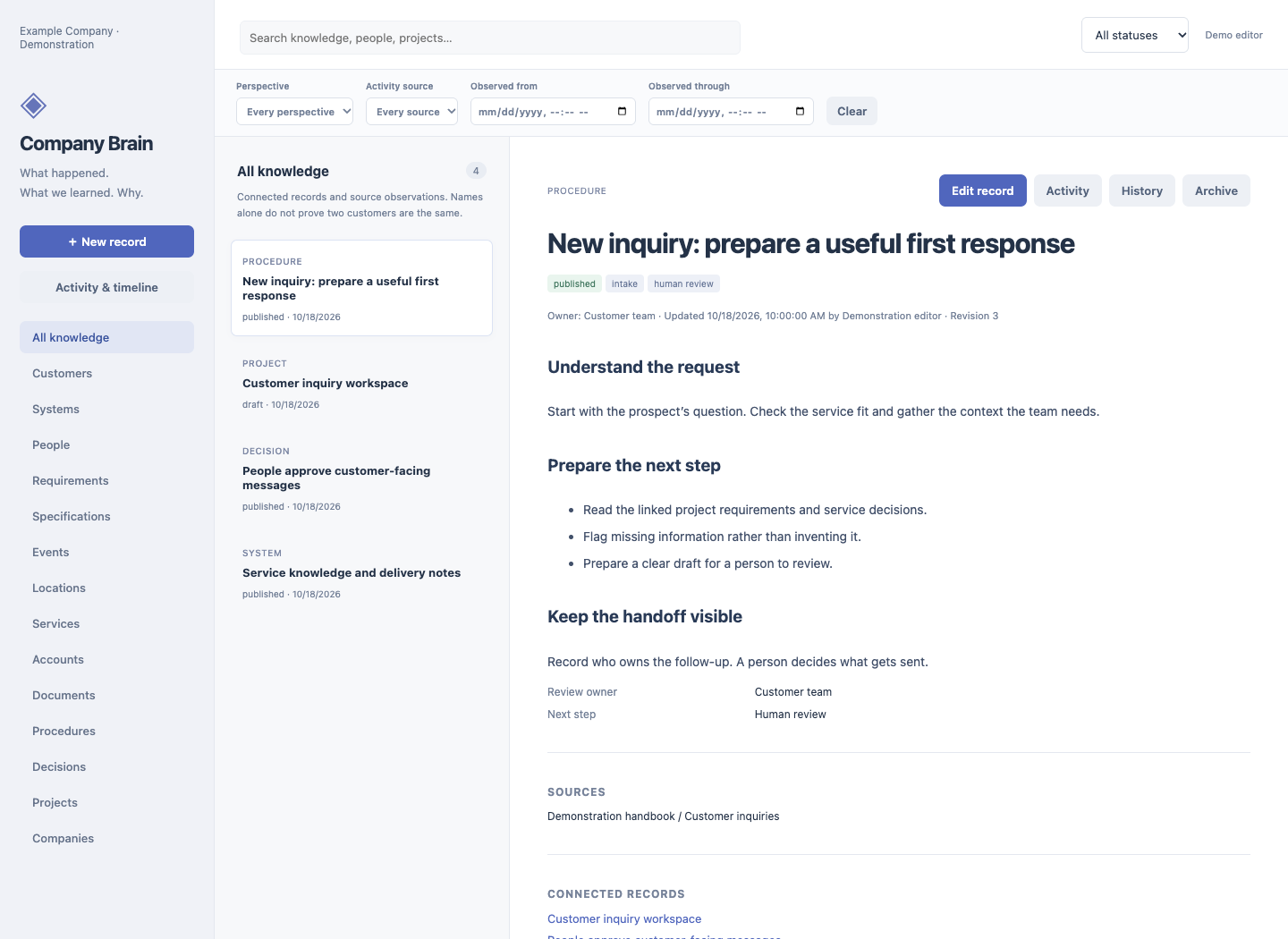
What the software does today
- Linked knowledge: typed records with related records and backlinks, plus tags and properties.
- Find the context: full-text search and filters for record type and publishing status.
- Keep the source: record source references, responsible owners, and the connections behind a decision.
- Review changes: revision history with author attribution, draft and published states, archive and restore.
- Support agent work: in configured OfficeCrew deployments, published records feed shared knowledge search and agents can use the Company Brain tool.
- Connect observations: source evidence, activity timelines, and perspective views help distinguish what was reported, when, and by which source. Collection depends on the configured deployment and supported inputs.
The current Brain is company-shared: enabled company members can read and edit its records, including drafts. It does not yet offer per-record permissions or private employee notebooks. We agree what belongs in shared knowledge during setup; personal-agent context remains a separate access decision.
One foundation, two uses
With OfficeCrew, company knowledge supports recurring operations, research, preparation, and handoffs. Agents have a place to find approved procedures and preserve useful context, rather than starting every request from zero.
With AppFoundry, business requirements, design decisions, and operating knowledge stay connected to the build. The aim is to preserve why the software works the way it does—not only the code that was delivered.
Company Brain is a standalone application as well as an optional agent integration. Sharing a foundation does not mean every customer application is automatically connected or every record is synchronized across systems. We scope those connections with you.
OfficeCrew: The Working Environment
Managed service · configured around your operation.
The web workspace gives your people a place to work with company agents. Slack or a supplied Buzz workspace can provide another entry point. Agent roles, knowledge sources, task-system connections, and human review are selected for the job.
T3ch5Claw is the underlying deployment platform used for our company-agent work. OfficeCrew is the customer-facing service: setup, useful roles, integrations, and ongoing operation. You do not need to choose an infrastructure stack to start a conversation.
Explore OfficeCrew, workspace choices, and example roles →
Projects and reusable procedures
Available in configured installs · verified with demonstration workflows.
Projects connects shared Company Brain context to nested projects, tasks, dependencies, and list or Kanban views. People and configured agents work from the same task records, with execution attempts and review kept visible. An agent reporting success does not accept the work; a person makes that decision.
Reusable project templates link to a specific published procedure. A person approves and publishes the template; the team can preview the resulting tasks before applying it with the agreed inputs. The resulting project retains its procedure and template version, and matching event retries reuse the same instance rather than creating another project.
Feedback and repeated project patterns can produce evidence-backed improvement proposals for human review. This does not train a model or silently rewrite procedures. Live checks used fictional demonstration work on two configured installs, including provider-backed agent execution; this is not evidence of completed customer work or availability in every deployment.
Projects currently uses company-shared context, not private project workspaces. External CRM triggers and automatic event collection are not included in this milestone; connections and rollout are scoped separately.
CRM: Relationships and Follow-Through
In development · local pilot running; customer integration not yet validated.
CRM belongs alongside Company Brain and the crew’s work. Its job is different: track contacts, companies, opportunities, conversations, and the next follow-up. Company Brain holds the connected knowledge that makes those interactions more useful.
A local Twenty pilot is running and its health endpoint has been checked. It is not yet a bundled or production-verified OfficeCrew feature. Mailbox setup, email behavior, permissions, backup and restore, and the agent workflow still need hands-on acceptance. Your existing CRM may be the right system to connect instead.
For example: an inquiry becomes an opportunity; company knowledge supplies the context; an agent prepares a response; a person reviews it. This is the intended workflow, not a claim that the full integration is available today.
AppFoundry: Build What Is Missing
Custom software service · delivered with your team.
When an existing tool cannot fit the process, AppFoundry builds the missing application, portal, dashboard, or integration. Company Brain can keep requirements and decisions connected to that work; OfficeCrew can help operate an agreed workflow after launch.
You can start with either service. There is no requirement to buy a custom application before putting a company agent to work.
Explore the AppFoundry build process →
From Development to Useful Capability
We expand this page as capabilities become real. Working code, a tested pilot, and a deployed feature are different milestones. Availability depends on the selected deployment; planned work is labeled as planned rather than presented as a finished product.